Brad Trogdon Tag | The Ring Finders

Engagement Ring Recovered on the Blue Ridge Parkway – North Carolina

  • from Winston-Salem (North Carolina, United States)

PSA: This search and recovery took place within the jurisdiction of the National Park Service (NPS). Metal detecting is strictly illegal in all units of the National Park System, including national parks, national monuments, national historic sites, national battlefields, and national seashores.

The Ring Finders member obtained approval and authorization to perform this recovery before arriving on location..

  • Prohibition: Under federal regulation 36 CFR 2.1, possessing or using a metal detector, or even carrying an assembled or unassembled detector in your vehicle, is against the law in NPS areas.
  • Archaeological protection: The Archaeological Resources Protection Act (ARPA) and the Antiquities Act prohibit digging, disturbing, or removing any historical or cultural resources from federal lands.
  • Penalties: Violations can result in steep fines, seizure of equipment, and potential criminal charges or imprisonment.

Request for Assistance

Wednesday

Early Wednesday morning I received this message:

“Good morning Brad, my parents sent me your link from Ringfinders after my fiancée lost her engagement ring while we were taking engagement photos on the Blue Ridge Parkway on Saturday (10/31). I don’t know if you travel out that far; it was at the Black Mountains Overlook. I have a lat/long marker. We searched for two days with no luck, but the photographer caught the moment it flew off her finger, so we know the approximate place. Anyway, I just thought I would reach out. It was fully insured, but the sentimental value is something else, and my fiancée is having a difficult time. Look forward to hearing from you.”
— Matt

I replied, “Absolutely,” and asked my routine questions, most importantly whether the drop area was a pedestrian area or secluded. He said they were alongside the paved road, a couple hundred feet away, and that it was not a high-traffic area. That removed any urgency or fear that someone might happen across the ring.

I asked Matt to forward any photos so I could research the likely search area. I also told him that because the search area was under National Park Service jurisdiction, I would have to request a permit, since even possessing a metal detector is prohibited there. The more detail we could gather, the better the chance the authorities would allow our search.

Matt explained that they had searched the immediate area thoroughly, even putting the leaves into buckets so they could search the ground and then search through the leaves. They also acquired a metal detector from a national tool supplier and scanned the area, but did not find the ring.

The photos he sent were clear, but they were pictures of the originals displayed on a computer monitor. I asked Matt to get the original RAW photos from the photographer if he could. He said he would have them later that evening when he returned home.

I then contacted the Park Service’s administrative offices, explained who I was, and told the story from the beginning: we had photographic proof and 100% certainty of where the ring would be, and the only obstacle was the ground cover, many inches of fallen leaves. I said I understood the prohibition on metal detectors and that NPS has the ability to grant an exception. The representative was very kind. After I left a detailed message on the permits coordinator’s voicemail, he gave me the number for the Rangers’ communications center and transferred me. I repeated all of the details to the communications center, and she said a supervisor would return my call.

Thursday

Matt forwarded the photos Thursday morning, and they were amazing. I noticed right away that some were rapid-fire shots. Luckily, those shots all showed the ring in flight, which gave me the idea of stitching them together into an animated image.

By reviewing the animation, I could see the angle and height of the ring’s apex and work out its trajectory. I wrote Matt that I was highly confident: I had identified a small search area, and with that level of detail we had checked all the boxes to get approval for the search from NPS.

The Assistant Park Superintendent called and said she was impressed by the level of detail we had gathered. She thanked me for following NPS rules and gave me the direct number for the Captain who supervises the Park Rangers. She said she would contact him, explain the situation, and confirm that we had authorization to search and to use the metal detector. He would coordinate and communicate our activities to the other rangers. She also asked me to wait an hour before calling, to give her time to speak with him.

After telling Matt we had permission, I called the Captain. He had spoken with administration and said it would be no problem. We agreed that I would contact the communications center to let them know when I was on property and beginning the search, and again when I was finished. He instructed me that if I was approached by a Ranger or park staff, I should have them contact him directly.

Matt was happy with the update. He wrote that the insurance company had requested a copy of the police report of the loss to process the claim. A man of faith, he wrote, “Praying that you’re able to find it and I can cancel the claim process.”

I asked for the ring’s specifics, since all I knew was that it was gold. The reply was 14k, size 6. Because I have a ring of those exact dimensions, I could test with it and know exactly what I was looking for.

Friday

Throughout the process I understood that Matt’s fiancée did not know he had contacted me or that a ground search was in the works. Before starting my commute, I asked whether he had said anything to her and whether he planned to surprise her once we recovered the ring. I told him I was highly confident and felt like a kid on Christmas Eve. He had not said a word, as he didn’t want to get her hopes up.

The commute to the search location was 2.5 hours from Forsyth County, and the drive was beautiful: leaves changing, mild temperatures, and Carolina blue skies. When I arrived, I walked to the spot I believed was correct and sent Matt a photo, asking whether they had left two large piles of leaves. He had, and he explained that was where they had been searching the leaves.

Begin the Search

There were no landmarks along the side of the road to base my search area on, so I placed four orange cones to square off the area. Two went by the road, approximately 20 feet apart. The other two were squared with the first pair, as close to the edge of the embankment as I could place them without them falling, so I could still see them from below road level.

With everything set, I first searched to rule out the flat area. Then I moved to the hillside and scanned as far as I could reach while standing on level ground between my markers. Next I sat down and slid down the hill so I could scan farther downhill.

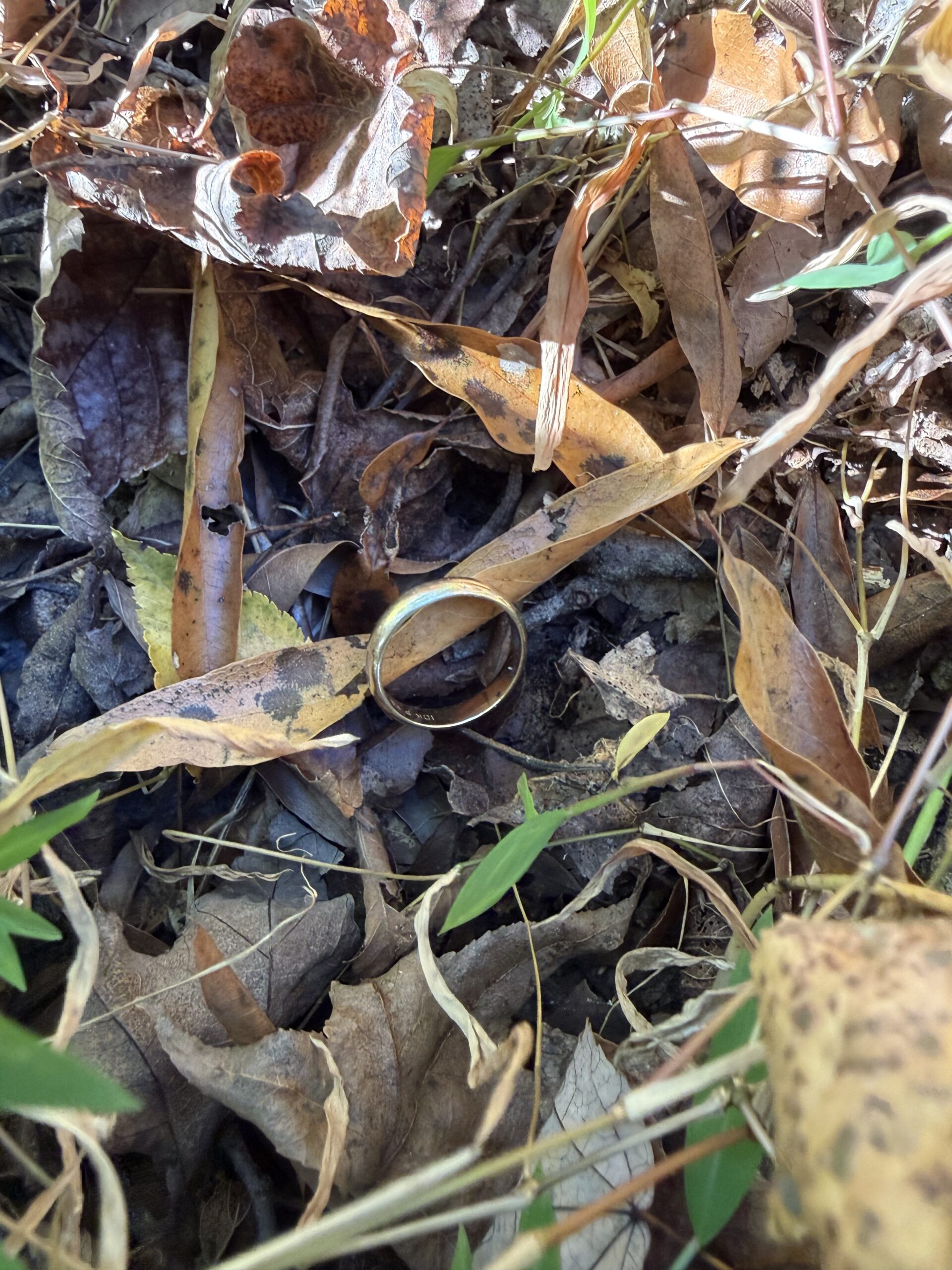
BEEP BEEP! It was exactly the VDI and sound I was looking for. The signal was at the far reach of my detector, so I had to slide down even farther to reach the spot. I used my pen pointer to locate it, then carefully lifted the leaves and scanned again to confirm the signal remained. With the leaves gone and the ground exposed, I still didn’t see a ring, but the soil was very soft. I pushed around with the pen pointer, which exposed the ring.  “Found it!”

Good News

Still sitting on the hillside, I sent Matt a message asking if he was sitting down, then sent a photo of the ring. The ring had been pushed into the ground. I can only assume that someone stepped on it during their initial search, pushing it below the surface. The hillside was very steep and slippery, and crawling on all fours was the only option.

The Scare

After sending my messages to Matt, I was still on the hillside when I heard something walking in the leaves behind me. Before I could turn around, I heard an exhale and then felt something cold and wet touch the back of my neck. As I was rising to launch myself downhill, I spotted a dog wagging its tail out of the corner of my eye. This could have been bad, but the Lord was watching over me, I am sure.

After I got to level ground, a pickup pulled up, and I realized the driver was a hunter and the dog was his. He told me it was bear season and the dog was out of his area. I explained how we had met, and he laughed a little.

Returning the Ring

I met Matt on my way home and returned the ring. His plan was to surprise his fiancée and call me afterward so I could tell her the story. She was so very nice and appreciative. I wish I could have seen the look on her face, because that is why we Ring Finders do what we do.

Thank you, Matt, for trusting me to find your treasure. Thank you to Matt’s mother, who found TheRingFinders.com and encouraged him to call. And thank you to the National Park Service for your part.

Another happy ending! If you have lost something, or you know someone who needs assistance, please reach out to TheRingFinders.com and locate a member in your area. Even if no one is in your immediate area, reach out to the closest one, as many members don’t mind traveling to help others.


For more photos and animation showing the ring inflight visit Brad’s FaceBook listing  – Click Here –


Heirloom Gold Ring Recovery: Moravian Falls, NC

  • from Winston-Salem (North Carolina, United States)

Justin reached out at 7:15 this morning with a message that sounded just short of panic: “Fiancé lost her gold ring somewhere on our property. I have a general location but we’ve walked over it so many times I’m sure it’s buried.”

The Story

Justin and his fiancée were spreading straw in their chicken run because the ground was too moist. During the task, she realized her ring was missing. She was understandably distraught. The ring had belonged to her grandmother and was a gift from her grandfather, and it meant a great deal to the whole family.

Coaching Over the Phone

Justin had already bought a metal detector from a franchised tool company and searched without luck. The machine kept alerting, but it only turned up nails, bolts, and aluminum.

I walked him through a few techniques:

  • Swing the coil as close to the ground as possible.
  • Overlap each swing by half the coil width to cover 100% of the ground.
  • If the detector has a sensitivity setting, turn it down so it isn’t deep scanning. The ring would be on the surface.

A short time later, I could tell he was getting frustrated. I reassured him that it takes practice to understand what a machine is telling you. I offered to come out and help, though it might be later that day or the next because of prior commitments. He said that would be great and that he would keep searching in the meantime.

Heading Out

I checked in around 2:30 pm, let Justin know I was halfway through my other job, and asked him to send his address. I estimated I could arrive around 4:30, which would leave plenty of daylight. Worst case, I would bring lighting to keep going after dark.

The Recovery

I arrived right on time and was greeted by the whole family. They showed me the paths she had walked, which they had pulled from the property’s security cameras.

I wanted to start where she had spread the straw. I scanned the covered section, then moved on to the next. On the first pass, I got a promising signal under a large pile of straw. I moved the pile aside and the signal was still there. Using my pinpointer, I pushed the straw away like a broom. Two more inches, and I could see the prize.

I retrieved the ring and placed it back in her hand. She became emotional, and I was even happier to return her grandmother’s ring to where it belonged.

Wrapping Up

We took a few photos and wrapped up another successful recovery. From arrival to placing the ring in her hand, it took only 10 to 15 minutes.

Thank you both for placing your trust in me and giving me the chance to help.


Men’s Wedding Band RECOVERED Along I-74, Winston-Salem, NC

  • from Winston-Salem (North Carolina, United States)

⚠️ SAFETY DISCLAIMER: It is not safe or recommended to walk along roadways, especially interstates, where vehicles travel between 65 and 80 miles per hour. Warning lights and high-visibility clothing were used for safety.

The Call

On Monday morning, October 12, I got a call from a man named Danny who asked if I could find a ring along the highway with a metal detector. I said yes. The interstate had been open only a short time, so trash and distracting signals should be minimal. Besides, I enjoy a challenge.

Danny had been driving in the fast lane of I-74 in Winston-Salem, talking on the phone. Just after passing the bridge, he casually tossed his gum out the window of his pickup at highway speed, and his wedding ring went with it. He stopped as quickly as he could and walked back to search. When he couldn’t find the ring he gave up, but he’d had the presence of mind to note the landmarks and drop a pin on his phone’s map where he stopped.

He described the ring as a wide, two-tone yellow gold band. We agreed to meet around 6:00 that evening. Danny planned to borrow a metal detector to help, though he had no experience and asked me to show him how to use it.

The First Search

At the interstate, Danny parked on the northbound side and I parked on the southbound side. Traffic leaving the city was very heavy at that hour. We met in the median, which was protected by guard rails. I helped him set up his machine, turned the sensitivity down, and explained what to listen for. I used my own ring so he could hear how it would respond. Then we walked south, carefully scanning the edge of the pavement with the detectors and the pavement itself with our eyes.

After about 90 minutes, a DOT Safety Patrol truck pulled up behind my car, but we kept searching. As daylight faded we called it a night. Before leaving, Danny handed me a $5 bill he’d found while searching. It was a very long walk back to my car, and I noticed the DOT Safety Patrol was now on the other side, talking with Danny.

To shorten the story: I returned alone the next afternoon and came up empty.

Turning to AI

My coworkers are programmers who rave about AI, so I fed it a very detailed prompt. It returned specific search areas based on speed, velocity, height, and the coordinates of Danny’s pin. I was impressed by how much it factored in: the vehicle type, speed, lane position, a 10-gram gold ring tossed from the driver’s window, and the GPS point where the truck stopped. It told me, in feet, how far back from the stop point to search and where to prioritize.

It outlined a “primary” area and an “extended” area, explaining that the extended area was needed because the driver’s reaction time was unknown, so it was making its best guess. It even covered wind drag and how the ring might bounce and roll, given the direction it was tossed and the forward speed it launched from.

I sent Danny the research along with an image showing the target areas overlaid on a Google satellite map. The base image was less than a year old, so it gave clear landmarks alongside the search zones. A real treasure map!

More Searching, No Luck

I returned Saturday morning and searched the marked areas until rain set in after an hour. Once it passed, I searched another 3 hours, again with no luck. I texted Danny to explain the area I’d covered. I was sure the AI had it right and the ring was somewhere in that zone. Danny said he’d go out and search as well.

I tried again the following week, but I arrived late, the sky was overcast, and it was getting dark, so I called it off.

One More Try

Over this Halloween weekend, I had already said “uncle,” but I just couldn’t give up. I went back to the AI with more details and “what if” scenarios about the road angle, including the possibility that the ring struck the guard rail on the median side.

On Sunday morning, I brought fishing weights tied with bright orange string for visibility. With no other vehicles in the area, I tossed each one toward the median at 65 mph to reenact the throw. One of three hit the rail and bounced back into the lane. Since the ring was round and the roadway tilts to the right, maybe it had bounced and rolled that way. Granted, that meant four lanes of traffic, but I had to give it another go.

This time I started at the base of the on-ramp and walked north, detecting the right side where the grass meets the pavement. This side had far more trash, so my detector alerted constantly. I investigated each good signal and moved on.

An hour and over a quarter mile later, I got the double beep I’d been waiting for. I looked but didn’t see anything, then rechecked with my pinpointer and found my treasure. The ring had clearly been run over a few times, but a good polish should take care of the road rash.

The Reveal

I was thrilled and wished someone was there to share the moment. I took a few photos to document the find, then headed out. I messaged Danny and asked if he’d replaced the ring yet. He said he’d bought a rubber one. I wrote back, “Wanna replace the rubber one?” and attached a photo of me holding his ring.

A minute later he replied, “You found it?” I said yes and offered to bring it to him. His kids were asleep, so we’re meeting Monday afternoon.

The Return

Monday afternoon I met Danny at his office and returned his ring.  I had cleaned it and polished the road rash out with his prior approval and he appeared very relieved to have his wedding band returned.

At 21 days, this was my most time-consuming, technical, and largest-area search to date. I’ve labeled this one the proverbial “Ring in a Haystack.”

Thank you, Danny, for reaching out and letting me help search for your treasure. I’m so glad it has a happy ending, even though it took three weeks. “We did it!”

Lost a ring, keys, or other metal item? Visit TheRingFinders.com to find a member in your area.

Lost Wedding Band of 47 Years Recovered: A Davidson County NC Ring Find

  • from Winston-Salem (North Carolina, United States)

On Friday, October 23, 2026, I received a text from Dana, who had found me through TheRingFinders.com. She asked if I could help find her husband’s wedding band. Her husband, David, had just realized the ring was missing and believed he lost it while doing yard work earlier in the day. He had worn it constantly for 47 years and was anxious to find it. They lived in Davidson County, between High Point and Thomasville.

I told Dana how sorry I was and that I would be glad to help. I asked how much of the yard he had worked in and whether he had been wearing work gloves, since rings often stay inside gloves when they’re removed. Dana said he had already checked his gloves, as that was his first thought. She explained that he had mowed a small area with the tractor and then loaded limbs and sticks into a trailer to dump in the woods behind their property, but she wasn’t sure how to describe the areas he had covered.

My phone then rang. It was David, who explained that while checking his gloves he had found a hole in the ring finger, large enough for the ring to slip out. He had no idea it was missing until that evening. He told me he had push mowed, tractor mowed, and hauled sticks into the woods, where he unloaded them by hand into a large pile. He had also blown leaves in the front yard and had no idea where the ring could be.

I had a hunch we would find it where he unloaded the sticks, since tossing them would involve the most force and the best chance for the ring to come off. We ended the call after he gave me their address, and I told him I would arrive first thing in the morning.

The commute was about 35 miles taking 40 minutes. I texted that I was on my way and would arrive around 9:00 AM. The GPS was accurate, and David met me as I pulled into the drive.
After introductions and handshakes, I gathered my metal detector and pen pointer and asked David to point out the areas he had covered and what he had done in each. We stopped just inside the woods, where he recalled emptying fireplace ash and scattering it around. That became my first search area, and it turned up nothing.

David then led me deep into the woods to a pile of limbs, leaves, and sticks covering an area of 20 feet by 10 feet, and 4 feet deep. I slowly detected the entire pile with no results. Because a ring could easily have fallen deep into the pile, far from the detector’s coil, we moved many of the larger sticks so I could scan closer.  Searched a second time, with negative results. After removing even more sticks and gridding the area thoroughly a third time, I was confident the ring was not in the pile.

Next, I started detecting the ground, beginning at the base of the wood pile and following the obvious tractor tire marks in the ground cover. About 10 feet in, I got a promising signal and found a can top. I explained to David that finds like this are common, and I kept searching. Five feet farther, I got another very promising signal. I looked through the ground cover and saw nothing, so I swept the detector coil over the area again and got a very strong signal. Using my pen pointer in about 6 inches of ground cover, I felt a bump and heard the telltale alerting sound. I spread the cover, and there it was.

I picked up the ring and asked David, “Does this look like your ring?” He seemed confused or thought I was joking at first and started walking toward me. When he saw the ring in my hand, his face lit up like a child’s at Disney. “I cannot believe it,” he said. “You found it, and I thought it was gone for good.” He immediately texted Dana to tell her the news.

Thank you, David and Dana, for calling and trusting me to find your missing treasure. From their first contact to recovery took less than 11 hours